Veneers in Oxnard CA for Stained or Worn Teeth
@cesarhepz835
A smile can age in ways people do not expect. Teeth darken gradually from coffee, tea, red wine, tobacco, and certain medications. Edges flatten from years of chewing. Tiny chips appear, then catch the light every time you talk. Some people reach a point where the problem is not pain, it is hesitation. They stop smiling fully in photos, cover their mouth when they laugh, or notice themselves speaking a little less freely in meetings.
That is often when veneers enter the conversation.
For patients dealing with stained or worn front teeth, veneers can be one of the most effective cosmetic options in modern dentistry. They are not a cure-all, and they are not the right choice for every mouth, but in the right case they can create a dramatic change with a very natural look. Anyone searching for Veneers Oxnard CA is usually trying to answer a few practical questions at once: Will veneers actually fix the kind of staining I have? Are they too aggressive for teeth that are just worn down a bit? How long do they last, and what will they feel like day to day?
Those are the right questions to ask.
Why stained and worn teeth can be harder to treat than they seem
Superficial tooth stains are often manageable with whitening, polishing, or improved hygiene habits. The more stubborn cases are different. Intrinsic stains, the kind that sit within the tooth structure rather than on the surface, may come from old trauma, developmental changes, certain antibiotics, or years of discoloration that bleaching simply cannot fully lift. Even when whitening helps, it may do so unevenly. A patient can end up with teeth that are brighter overall but still patchy, gray, or translucent at the edges.
Worn teeth present another layer of complexity. Mild wear can make teeth look older before it creates any real sensitivity. The teeth lose their crisp outlines. Front edges become shorter. Corners round off. In some people, especially those who clench or grind at night, the enamel thins enough that the teeth begin to look small, flat, or almost see-through.
This matters because color and shape work together. A tooth that is only stained may benefit from whitening or bonding. A tooth that is both stained and worn often needs a treatment that can restore brightness, proportion, and surface texture at the same time. That is where veneers are often strongest.
What veneers actually do
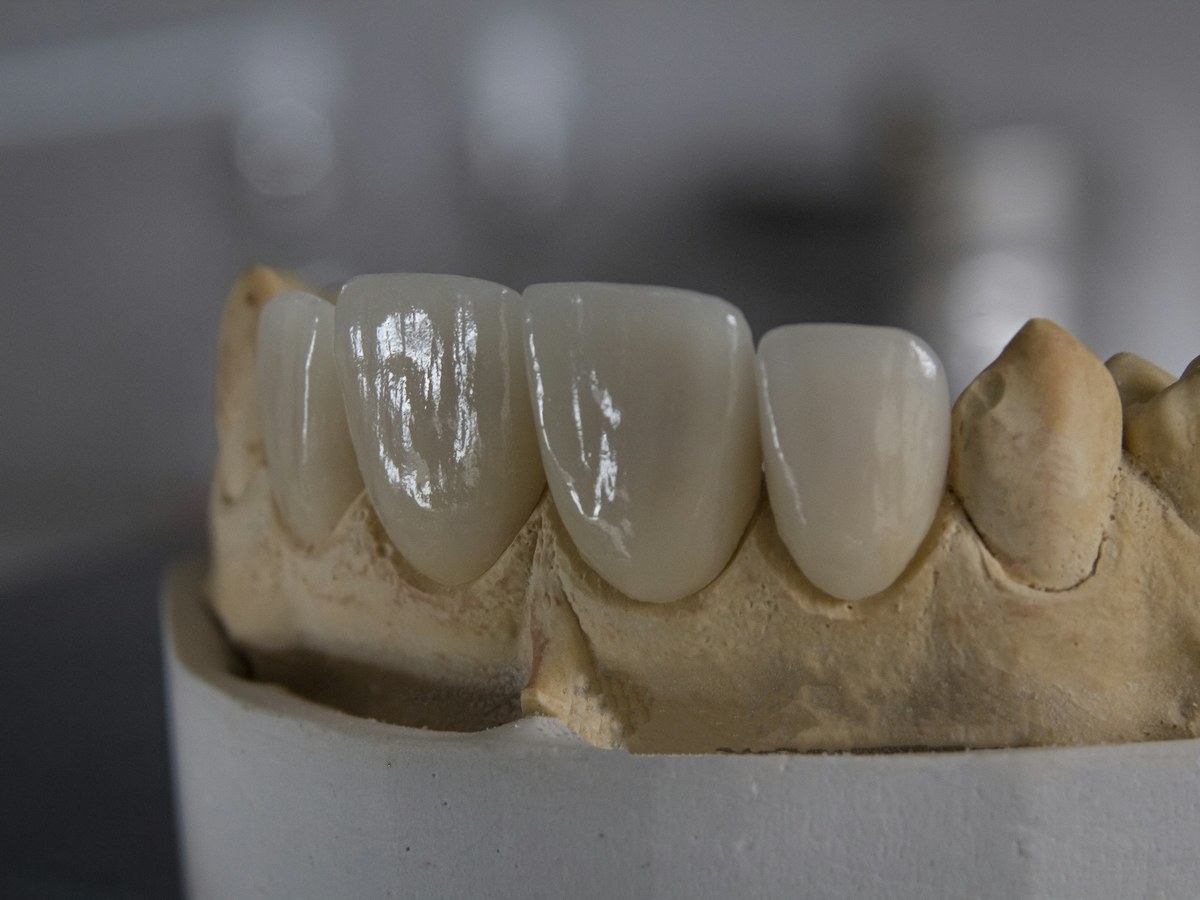
A veneer is a thin facing, usually made of porcelain or a high-quality ceramic, that bonds to the front surface of a tooth. It can change the visible color, contour, length, and symmetry of that tooth. In skilled hands, veneers can make teeth look healthier and more balanced without creating the bulky, overly opaque appearance people fear.
Porcelain veneers are especially useful for stubborn discoloration because the material can mask underlying darkness while still reflecting light in a way that looks lifelike. That balance is the art of the work. If veneers are too opaque, they can look flat and artificial. If they are too translucent, dark underlying tooth structure can show through. Good treatment planning accounts for both.
For worn teeth, veneers can rebuild what time and habit have taken away. If the wear is mainly on the front surfaces and biting edges, veneers can restore lost length and shape beautifully. If the wear is severe or reaches the back teeth and affects the bite, the case may need a more comprehensive plan. That might include crowns, bite adjustment, or nighttime protection in addition to veneers.
When veneers make sense, and when they do not
Patients are often relieved to hear that veneers are not the automatic answer for every cosmetic concern. A conservative dentist will look first at the simplest option that can genuinely solve the problem.
Whitening can be enough if the teeth are healthy, well shaped, and mostly stained on the surface. Bonding can work well for small chips or isolated defects, especially if the budget is tighter or if the patient wants to preserve as much natural enamel as possible. Orthodontic treatment may be a better first step if the real problem is crowding, spacing, or tooth position.
Veneers make the most sense when the visible issues overlap. That is common in adults who have lived with their teeth for decades. Their concerns are not just “I want whiter teeth.” It is more often, “I want these front teeth to stop looking dark, uneven, and worn down.” Veneers can address all of that in a single coordinated result.
Here are several signs that veneers may be worth discussing with a cosmetic dentist:
- Whitening has not corrected the discoloration enough, or the results look uneven.
- The front teeth appear shortened, flattened, chipped, or visibly worn.
- Old bonding keeps staining or breaking and needs frequent repair.
- The patient wants a longer-lasting cosmetic change with more control over shape.
- The underlying teeth and gums are healthy enough to support durable treatment.
Those points are not a diagnosis, but they capture the pattern seen in many veneer cases.
The importance of enamel, bite, and gum health
The best veneer cases begin with healthy fundamentals. That sounds obvious, but it is easy to focus on the cosmetic result and overlook the biology underneath it.
Enamel matters because veneers bond best to enamel. When a tooth still has a good enamel foundation, the bond is generally stronger and more predictable. If there is extensive existing dental work, major decay, or a large amount of enamel already lost to wear or erosion, the treatment plan may need to shift. In those situations, crowns or other restorative options can sometimes be more appropriate than veneers.
Bite matters because cosmetic work has to survive function. A patient who clenches hard, bites edge to edge, or has significant grinding patterns can absolutely still get veneers, but that risk factor needs to be managed. Sometimes the design can be modified. Sometimes the sequence changes, so the bite is stabilized first. Often a night guard becomes part of the long-term plan. Ignoring bite forces is one of the quickest ways to turn beautiful dentistry into a repair cycle.
Gum health matters because veneers sit at the visual boundary where tooth meets gum. Inflamed gums bleed, swell, and change shape. A smile that looked balanced at delivery can look different if gum disease or poor home care develops later. Patients tend to judge veneers by the front-facing result, but the nicest ceramics in the world cannot compensate for neglected gum health.
How the process usually unfolds
Veneer treatment is often less mysterious than patients expect. The details vary by office and by case complexity, but most people go through a similar progression. It begins with an exam, photos, and a discussion of what bothers them most. Not every patient speaks in dental terms. Some say, “My teeth look gray.” Others say, “They seem too short,” or “They all blend together in pictures.” Those observations are useful. They tell the dentist where aesthetics and self-perception intersect.
From there, planning becomes highly visual. Many cosmetic dentists use digital imaging, study models, or a wax-up to map the proposed changes. This stage is more important than patients realize. It is where decisions get made about tooth length, width, edge shape, and how bright the final smile should be. The best veneer cases are rarely the brightest. They are the most believable.
If the patient moves forward, the teeth are prepared conservatively, often removing a small amount of enamel from the front surface, though the exact amount depends on the case. Temporary veneers may be placed while the final restorations are being fabricated. The temporary phase can be surprisingly helpful. It lets the patient “test drive” the new look and gives the dentist feedback on phonetics, comfort, and shape before the porcelain is finalized.
At the final appointment, the veneers are tried in, assessed, and then bonded. Bonding is not just a technical step, it is the make-or-break moment for fit, color integration, and margin quality. A carefully made veneer still depends on careful placement.
What patients often notice after veneers
The first reaction is usually visual. People see brightness and symmetry right away. What they do not always expect is how much edge position affects their face. Restoring a few millimeters of lost length can make the smile look younger and more energetic, even if no one looking at them could explain why.
Speech may feel slightly different for a few days, especially with sounds like “f” and “v,” because the front edges of the teeth influence phonetics. This typically settles quickly. The veneers should feel smooth and integrated, not thick or foreign. If a patient keeps noticing an edge with the tongue after the initial adjustment period, it is worth having the dentist refine it.
Sensitivity varies. Some patients have almost none. Others experience mild temperature sensitivity for a short time after preparation and bonding. That is usually manageable and temporary when the case is planned well.
One thing I have seen repeatedly in cosmetic cases is that patients are often more emotional than they expect to be. Not dramatic, just quietly affected. A person who has spent years editing their smile can feel a very real sense of relief when that self-consciousness finally lifts.
Porcelain veneers versus bonding for worn or stained teeth
Bonding and veneers are sometimes spoken about as if they are interchangeable. They are not. Both have value, but they behave differently over time.
Composite bonding is placed directly on the tooth. It is more conservative in some cases, often less expensive up front, and can be an excellent choice for small repairs or limited cosmetic improvements. It is also easier to modify and repair chairside. The trade-off is durability and color stability. Composite can stain, lose polish, or chip more readily than porcelain, especially on heavily used front edges.
Porcelain veneers usually cost more and require lab fabrication, but they offer stronger stain resistance and a more stable surface finish over the long term. For someone with significant discoloration and visible wear, porcelain often gives a more refined and longer-lasting result. It also allows a greater level of control over translucency and texture, which is a major part of what makes cosmetic dentistry look natural rather than obvious.
That does not make porcelain “better” in every case. It makes it better for certain goals.
What “natural-looking” really means
Patients frequently ask for a natural result, but natural is a broad word. In practice, it usually means a few specific things. The teeth should suit the person’s face. They should not all be identical rectangles. The brightness should look healthy, not fluorescent. Surface texture should catch light softly instead of looking uniformly flat. The edges should have some character.
Real teeth are not perfect in the mathematical sense. The best veneer cases preserve enough individuality that the smile still belongs to the person wearing it. In Oxnard, where lifestyles range from professional office settings to outdoor, coastal routines, I have noticed that many patients want exactly that balance. They want to look polished, not manufactured.
Searching for Veneers Oxnard CA often brings up heavily edited before-and-after galleries. Those can be useful, but they can also skew expectations. A strong cosmetic result does not need to look dramatic at arm’s length. Often the best cases look almost unremarkable at first glance, then increasingly impressive the longer you look because the harmony is so well done.
Longevity, maintenance, and the habits that matter most
A fair question is how long veneers last. There is no single promise that applies to every mouth. In general, well-made porcelain veneers can serve for many years, often well over a decade, especially when bonded to sound enamel and cared for properly. Some last much longer. Others fail earlier because of grinding, trauma, decay around the margins, gum recession, or simply poor case selection from the start.
Maintenance is not difficult, but it does require consistency. Veneers do not decay, but the teeth underneath them still can. Plaque still collects at the edges. Gums still react to neglect. Hard objects still chip ceramic when used as tools.
The daily rules are straightforward and more important than any fancy product:
- Brush thoroughly with a non-abrasive toothpaste and floss every day.
- Wear a night guard if you clench or grind, especially if your dentist recommends one.
- Avoid using front teeth to open packages, bite nails, or crush ice.
- Keep regular dental visits so small issues at the margins are caught early.
- If you notice a change in bite, a chip, or persistent sensitivity, get it checked promptly.
That kind of routine goes a long way toward protecting the investment.
Cost is part of the decision, but not the whole decision
Veneers are elective in most cases, so cost naturally matters. Fees vary based on the dentist’s training, the complexity of the case, the materials used, the lab quality, and the number of teeth treated. A single veneer case is very different from a full smile redesign involving eight or ten front teeth. Because prices shift over time and differ from office to office, it is more honest to discuss cost as a range rather than cite one number as though it fits everyone.
Patients should be cautious about shopping for veneers on price alone. Cosmetic dentistry is one of those areas where cheap work can become expensive work very quickly. Replacing bulky, poorly fitting, or over-prepared veneers is much harder than doing the case properly the first time. The better question is not simply “What do veneers cost?” but “What level of planning, customization, and follow-up is included in that fee?”
A careful consult should cover more than price. It should explain why veneers are being recommended, whether there are alternatives, how many teeth need treatment for a balanced result, and what kind of maintenance will be expected afterward.
Questions worth asking at a veneer consultation
A good consultation should feel collaborative, not rushed. Patients do better when they understand the reasoning behind the plan. A few questions can reveal a lot about how a dentist approaches cosmetic treatment.
How much of my natural tooth structure will need to be altered?
Is whitening, bonding, or orthodontics a realistic alternative in my case? How will you design the veneers so they match my face and not just a generic ideal? What happens if I grind my teeth or already show signs of wear? Can I see examples of cases similar to mine, especially stained or worn teeth rather than only spacing cases?The answers should sound specific, not scripted.
Special considerations for stained teeth
Not all stains respond the same way under veneers. Deep gray discoloration is different from yellowing. Tetracycline-type banding is different from a single dark tooth that has had trauma. These details influence how opaque the veneer should be, whether more tooth reduction is needed to create space for masking, and whether the surrounding teeth should be whitened first so the final blend is more attractive.
This is one of the common pitfalls in cosmetic dentistry. If the planning ignores the depth and character of discoloration, the final result may look too thick or still slightly shadowed. A seasoned cosmetic dentist will assess the underlying color carefully and, when needed, coordinate prep design and ceramic selection to control the outcome.
Special considerations for worn teeth
Wear tells a story, and the story matters. Some wear comes from age and normal use. Some comes from grinding, acid exposure, reflux, or Veneers Oxnard CA habits like chewing pens and ice. If the cause is active, the cause needs attention along with the cosmetic repair.
For example, a patient with acidic erosion from frequent sports drinks may get beautiful veneers and then continue damaging exposed tooth surfaces elsewhere. A patient with strong nighttime grinding may chip even well-made porcelain if there is no protective plan. Cosmetic treatment works best when it is tied to diagnosis, not just appearance.
Worn teeth also require judgment about how much length to restore. Patients often want their old teeth back, but not every mouth can tolerate a dramatic increase in front-tooth length without adjusting the bite. Sometimes a conservative gain looks better and lasts longer than a maximal one. Restraint is part Veneers Oxnard CA of quality.
Choosing the right provider in Oxnard
When people look for Veneers Oxnard CA, they are not just looking for a location. They are looking for someone who can handle nuance. Cosmetic dentistry is one of the most technique-sensitive services in a dental office. Materials matter, but planning, preparation, communication with the lab, and bonding protocol matter just as much.
It helps to look for a dentist who spends time on diagnosis and smile design rather than jumping straight to tooth preparation. Before-and-after photos are useful when they show cases with problems like yours. Reviews can offer clues, though they should not replace a direct conversation. During the consultation, pay attention to whether the dentist discusses limitations and trade-offs. That is often a sign of maturity and honesty.
A provider who promises perfection or dismisses concerns too quickly is not necessarily the safest choice. Good cosmetic dentists know how much small details matter, and they usually speak with that level of care.
The bigger picture behind a small piece of porcelain
A veneer is a thin restoration, but the decision to get veneers is rarely superficial. For many adults, especially those with teeth that have darkened or worn down over years, it is about feeling aligned with how they carry themselves in every other part of life. They may take care with their work, their health, and their appearance, yet still feel that their smile looks tired or neglected despite good hygiene.
When veneers are the right treatment, they can correct long-standing discoloration, rebuild worn edges, and bring back a sense of ease that patients often miss more than they realized. The key is not simply getting veneers. It is getting the right treatment for the right reasons, designed by someone who respects both aesthetics and function.
That is the standard worth aiming for, whether the concern is one dark front tooth, a row of worn incisors, or a smile that no longer reflects the person behind it.
Oxnard Dentistry
1730 E Gonzales Rd, Oxnard, CA 93036, United States
+1 805-307-8731
FAQ About Veneers Oxnard CA
How long do porcelain veneers last?
Porcelain veneers can last for many years, but they can chip, loosen, or wear over time. Their lifespan depends on factors such as your bite, whether you grind your teeth, and daily care. Regular dental visits let your dentist check their condition.
Are dental veneers permanent?
Traditional veneers often require removing a small amount of enamel, so that change to the tooth is generally irreversible. Veneers can still need repair or replacement. Ask your dentist how much preparation your teeth would require.
How much do veneers cost in Oxnard?
Cost depends on the material, how many teeth you want treated, and whether you need other dental work first. Ask for a written estimate that explains the price per tooth and what is included.